
Novels About Overcoming Difficult Childhood: What Sets Heartbreak Farm Apart
There is a version of this story that gets told often. The damaged child, the redemptive adult figure, the slow climb toward healing, the ending that promises everything is going to be alright. It follows a shape the reader recognises and the shape does most of the emotional work so the writing does not have to.
Heartbreak Farm does not follow that shape.
Patrick Budden is not interested in redemption as a tidy arc. He is interested in what actually happens when a child who has been failed by the people responsible for him finds, by chance and through his own stubbornness, something worth holding onto. The difference is not small. One version offers comfort. The other offers truth.
Dick’s difficult childhood does not resolve. His mother is still dead. His father is still in prison. The years of making excuses for a man who would not visit a dying woman, the eviction, the squat, the weeks of walking streets that led nowhere, none of that is undone by the farm. What the farm offers is not a cure. It is a context. A place where the parts of Dick that his circumstances had not yet destroyed, the work ethic, the observational intelligence, the refusal to become what surrounded him, could finally be of use to someone.
That is a harder and more honest version of overcoming than most fiction provides. It does not promise that surviving a difficult childhood leaves you whole. It shows what a person can build from what is left.

Survival and Recovery Childhood Stories: The Specific Shape of Dick’s Survival
Survival, in Dick’s case, did not look heroic. It looked like walking away from a squat before dawn and trying the same streets again. It looked like being turned down for work all day and trying again the next day. It looked like finding a farm lane and walking up it without any particular reason to think it would lead anywhere different from everywhere else he had tried.
There was no single moment where Dick decided to survive. He just kept moving.
That quality, the absence of drama in his own self-preservation, is one of the things that makes him such a specific and credible character. Patrick Budden never asks the reader to admire Dick’s resilience because Dick himself does not think of it that way. He is not resilient as a conscious act. He simply has not stopped yet. The stopping, it turns out, comes later, for different reasons, after he has already built everything he set out to build.
Recovery, for Dick, takes the shape of routine. The four-thirty start. The chickens, the eggs, the bullocks, the tea. The physical repetition of farm work, tasks that require your full attention while you are doing them and leave your body tired enough at the end of the day to sleep properly. There is something in that rhythm that Budden understands from the inside, the way occupation can hold a person together when nothing else is.
Dick does not talk about what the farm does for him. He just gets up every morning and does the work. That is its own kind of recovery. It is also, quietly, the most convincing portrait of it.

The Childhood That Made Dick Who He Is
Before his mother died, Dick had been a boy with a family. His parents were a couple, their relationship is not described in detail but its absence, once it is gone, explains everything. His mother was the person who held the household together. His father needed her to hold him together too, it turned out, more than anyone had known until she was not there to do it.
Dick does not talk about what his childhood looked like before everything fell apart. But the way he behaves on the farm suggests he came into it knowing more than most boys his age about keeping things in order. He notices what needs doing without being told. He keeps track of things. He takes responsibility for tasks before they become problems. Whatever shaped that in him, it shows.
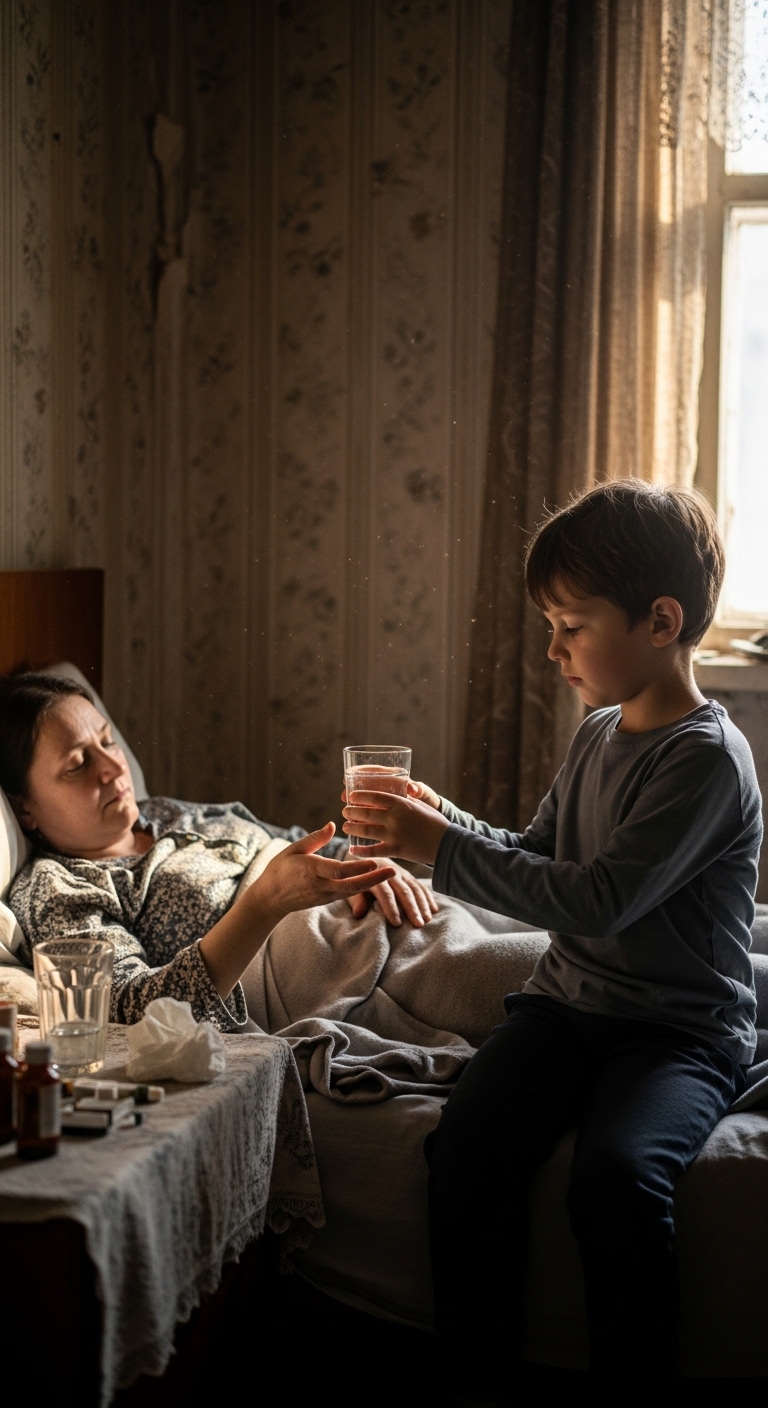
When she got sick, Dick became the person who managed things. He looked after her. He covered for his father. He held the shape of the family together with the only tool he had available, which was pretending, every day, that things were closer to normal than they were.
By the time he arrived at the farm he had been carrying an adult’s weight for months, on top of the grief, on top of the eviction, on top of everything else. He was a teenager. He should not have had to know how to do any of it.
But he did know. And on the farm, that knowledge became something useful instead of something that had cost him everything. Joe and Gwen did not know they were getting someone who already knew how to hold things together. They found out gradually, one morning at a time.
Gwen’s Role in Dick’s Recovery
Joe gets the practical credit in Heartbreak Farm. He teaches Dick the farm. He includes him in the market, the harvest, the daily machinery of a working agricultural life. His respect, when it comes, comes through action, more responsibility, harder tasks, the occasional blunt acknowledgement that something was done well.
But Gwen is the reason Dick stays long enough to receive any of it.
She is the one who opened the door. She is the one who fed him before she knew whether his story was true. She is the one who argued for him when Joe’s first instinct was caution, and who made the room comfortable before he got to it, and who noticed when he was sad and found practical ways, a warm meal, an easy conversation, the ordinary domestic warmth of a house that ran well, to make it slightly less so.
For a boy whose mother had been dead for more than a year, whose experience of home had become a squat and before that a household held together by his own effort and grief, Gwen’s kitchen was something he did not have words for. Budden does not give him words for it. He just shows Dick eating everything on his plate and saying, That’s the first proper meal I’ve had since my mother died.
She does not make a big thing of that. She just keeps feeding him.
That is what recovery looks like from the outside when it is happening quietly and well. Someone in a warm kitchen who keeps showing up. Who does not need you to be fixed to treat you decently. Who trusts that decent treatment, given consistently, will do more than any amount of direct intervention.
Gwen is not a therapist or a social worker or a mentor in any formal sense. She is a farmer’s wife who opened her door. In Heartbreak Farm that turns out to be exactly enough.

What Patrick Budden Understands About Young People Today
Patrick Budden is seventy-eight. He has watched several generations navigate the world, and his view, stated plainly in the author’s note at the back of Heartbreak Farm, is that the younger generation today has a harder time than the youth of yesterday.
Dick is his proof of that argument made flesh.
The systems that should have caught Dick, the welfare safety net, the housing support, the school that expelled him were either absent or actively unhelpful. The employers who would not consider him because he had no address were following a logic that made sense from their side of the counter and condemned him from his. The squat, the streets, the slow erosion of any reasonable expectation that things might improve, none of that was inevitable. It was the product of a set of circumstances that a more attentive system might have interrupted at half a dozen points.
Nobody interrupted it. A dog made a favourable assessment of him in a farmyard and a woman trusted the dog.
Budden does not turn this into a political argument. He does not editorialise about systems or policy or the state of provision for young people in crisis. He simply puts Dick in front of the reader in enough detail that the reader can draw their own conclusions, and the conclusions are not comfortable.
The boy who turned up at the gate was not exceptional. He was just the one who happened to find the right gate. Heartbreak Farm is, among other things, a quiet question about how many others did not.
Buy Now on Amazon
Dick arrived at the farm with nothing and built something worth having, a skill, a place, a purpose, a version of himself that Joe and Gwen would have recognised as their own.
Heartbreak Farm by Patrick Budden is available now on Amazon. A coming of age novel about teenage struggle, unlikely belonging and the particular damage of growing up without anyone to catch you, written by a 78-year-old debut author who understands, without flinching, what that costs.

The Farm Is Still Running. Dick Made Sure of It.
If you read fiction for the feeling of being somewhere completely real, a place with its own smell and its own cold and its own dog that runs ahead without being told, Heartbreak Farm will put you on that farm and keep you there.
If you are drawn to stories about ordinary decency, people who take in a stranger not because it is easy but because Jess seemed settled and Gwen trusted her instincts, this novel is full of it.
If you want a book that does not manage your emotions for you, that does not tell you how to feel about what it shows you, that simply sets things in front of you and trusts you to understand their weight, Patrick Budden writes exactly that way.
And if you have ever lost someone who held everything together, and felt the particular disorientation of a world that keeps going when the person who made it make sense no longer does, this book will find you where you are.
Heartbreak Farm is a short novel. It does not waste a word. Some readers will finish it in an afternoon and sit with it for weeks. It is that kind of book, the kind you press into someone’s hands without much explanation, because any explanation would get in the way.
quote by Patrick budden
“Don’t think I didn’t like you two as much as I did Joe and Gwen, but I didn’t want to get too close, because everyone I do get close to dies. I want you two to live a very long and happy life. Forgive me for putting you through all this, but I can’t stay any longer.
Good luck, God bless you both. All my love, Dick.
Please take care of Jess.”